by | NADIA SULLIVAN, nadiasullivan@might.org.my
Identifying and challenging our assumptions about “wild card factors” is critical if we’re ever going to be able to weather no-notice catastrophic events that could dramatically alter the status quo. Events such as political instability, unrest, terrorism, cyber security breaches, regulatory compliance failures, natural disasters, supply chain disruptions and many more are looming crises that could be triggered beyond government control.
Beyond the immediate fallout of a crisis, governments all over the world are starting to feel pinched. As a result, most governments view tightening the law as a way to get a handle on future needs and withstand future shocks. By doing so, governments can empower their agencies and regulatory bodies with the ability to enforce and penalise perpetrators who commit offences they couldn’t have imagined some distant 20 years ago.
Well thought through legislation is a component of regulatory policy. It provides governments with a clear guidance on certain issues. To be clear, it advises governments on the effective use of regulation to achieve better political, social, environmental and economic prosperities. What accounts for the success of legislation? Regulatory policy and legislation are increasingly recognised as a precondition to implement better governance. Conversely, poorly drafted legislation creates legal ambiguity and insecurity, therefore poses a hurdle to the consistency of government delivery systems.
The assumption that regulation can be crafted slowly and deliberately, and then remain in place, unchanged, for long periods of time, has been upended in today’s fickle environment. As new business models emerge and unprecedented events forcing a sudden economic shift, governments’ hands are forced to modify and enforce regulations.
Therefore, regulations play a significant part in the reform of public services. But for change to occur, it largely depends on how public service’s systems are organised. As public service’s long overdue transformation requires a mighty endeavour and a sense of urgency, so does the sector’s regulatory systems.
For one thing, this article deliberates the need for the public service to reform through a legislation lens. Essentially, this article probes public service’s most complex regulation challenges to provide suggestions whether enacting new laws to cater to a fast-changing ecosystem will result in better public service delivery. Also, by looking at the sector’s performance determinants, this article explores the intermingling of law and current affairs to protect the public service ecosystem.
Agile legislation beyond times of crisis
Today’s public service leaders are under immense pressure to do more with less. They are tasked to address a complex range of ever-expanding issues. And, government leaders at the top require them to be quick-thinking and responsive to their whims and escalating demand. However, public service leaders face difficulties to keep up. As information travels very fast these days, policies become out of date even before they are completed. No single leader, no matter how senior they are, is able to orchestrate the solutions alone. In turn, public leaders struggle to act effectively as a result of weak signals of changing needs.
Being ready and responsive public service is paramount. However, there are limitations imposed by legislation, community will and resources. As a countermeasure, the public sector needs to be creative and entrepreneurial.
In times of crisis, regulations, policies and laws are required to be agile at best. In weathering the COVID-19 pandemic, unforeseen circumstances have pushed us to consider doing things differently. For instance, the way we work, shop, exercise will be altered as does the way we value things. People are shutting in and vocal citizens have raised their grave concerns over how the public service should comply with the pandemic environment. Social and business gatherings need to act in accordance with legal provisions. Perhaps, it is time for governments to start looking into this and consider the transition. Who knows, this could be the X factor that could contribute to a public service reform.
Remote working
Although some might be at odds with some vague remote working polices, working remotely has become commonplace in today’s working environment. With the ease of plugging in and connecting from just about anywhere, employees have the flexibility and convenience of working from home, coffee shops, libraries, and so on.
A work from home policy offers a variety of benefits to both remote employees and their employers. According to Forbes, remote work can lead to increased productivity and more efficient employees as they are less distracted than in an office setting. Remote workers experience less stress as they don’t have to deal with the hazards of commuting, and lower stress levels lead to higher morale. Yet, with remote working, employers incur lower overhead operating costs while still ensuring work runs smoothly. As a result, employers may also see a reduction in severity compensation.
In a nutshell, the working landscape is changing. Regardless of the current situation, be it a pandemic outbreak or a natural disaster, proactive steps need to be taken to put governments and businesses in a better position for the new normal. In addition, governments and businesses need to look into working from home as an pilot experiment as a groundwork for proper policy formulation in the future.
Data online privacy
Data is now the new social good. And governments need to think of some form of data legislation that guides private sector and other data owners of their responsibility in collecting, managing and sharing data. Saliently, governments need to keep a close watch on these entities’ conduct in order to prevent data breaches.
In addition, governments need to design a new system for advanced data processes and management. The capacity to capture and process large swathes of data as well as store data in a way that captures its context must be scaled. To enable such processes, governments must review several laws and regulations to ensure there is no contradiction to the quality and value of data captured, as the decision making may be jeopardised if the data is not accurate or timely.
Managing the shift to virtual health services
The future of healthcare systems will be supported and strengthened by telemedicine. Through seamless and almost universal availability of information and virtual services, telemedicine will dramatically change the way the public and healthcare professionals interact with their healthcare systems. People will access healthcare services and manage their personal health in an empowered and knowledge-rich environment. Telemedicine will also significantly reshape the working environment of healthcare professionals, as new technologies and services are introduced to directly support front-line personnel.
Appropriate laws and regulations have been developed to support telemedicine (e.g., Telemedicine Act, Digital Signature/Contract Act, Computer Crime Act, Multimedia Intellectual Property Act, Electronic Government Act) while protecting the people’s rights. This is to avoid technological innovation in health services outpace its regulatory capability. However, telemedicine may need modification from time to time to ensure its development continues to be relevant. An enabling framework of appropriate laws, policies, regulations and standards will be required to underpin the processes and ensure effective operation of virtual healthcare delivery.
Remote drones
With recent advances in Unmanned Aerial Vehicle (UAV) technology, it is now possible to deploy autonomous UAVs to assist public service officers. Equipped with handy features such as in-progress call for service, remotely deployed UAVs can be used to provide officers with real time information, making their jobs safer and at the same time, increases crime solving and documentation efficiency.
Currently, Malaysia has no firm framework for commercial drone operations. However, the Civil Aviation Authority of Malaysia (CAAM) has jurisdiction over the sector. In light of recent COVID-19 outbreak, CAAM has given authorisation to the police force to operate drones for surveillance and enforcement during the second phase of the Movement Control Order (MCO).
Therefore, having an agile legislation is crucial especially in cases like this, as it would help public service officials working as front liners to collect data in an environment or a condition dangerous to humans. Drones should be able to help in various ways to mitigate public service staff shortage and reduce their exposure to the virus. Another potential benefit is the use of drones to sanitise cities.
3D printing technology
Nearly all technological advances pose challenges to law and governance. Although it has become clear that some new technologies are here to stay, as far as legislation is concerned, there is no single law that governs the 3D printing technology in Malaysia. Plenty of businesses and the public need to understand the legal implications surrounding the technology as 3D printing and design may fall under the purview of the copyright, trade dress and patent law.
Given the emergence of the 3D printing industry and the state of flux in the law, it is recommended that brand owners and IP-related associations continue to monitor the law of trade dress, copyright, design and patent. While a public policy might support the barring of 3D printing of regulated and contraband items such as pharmaceuticals and guns, such printing activities would not implicate trade dress or other design laws if the designs are not protectable.
Digital-ready legislation
With many people quarantined in their homes, governments all around the world are under pressure to become more efficient. Digital experiences matter more than ever now as COVID-19 is radically accelerating a digital future.
Today’s legislation is so complex that it may be difficult for citizens and businesses to understand what rules apply. Legislations with many exceptions, unclear concepts or multiple case processing requirements are difficult to administer and can result in long delays and prevent efficient management of digital opportunities. In today’s digital society, it is important that effective administration of new rules is taken into account across legislative work.
This means, in the future, as we are moving towards digital by default, legislation should strive towards using terms and concepts that have a clear definition across all legislative domains, and rules should be designed for a whole or partial automation of the case processing involved.
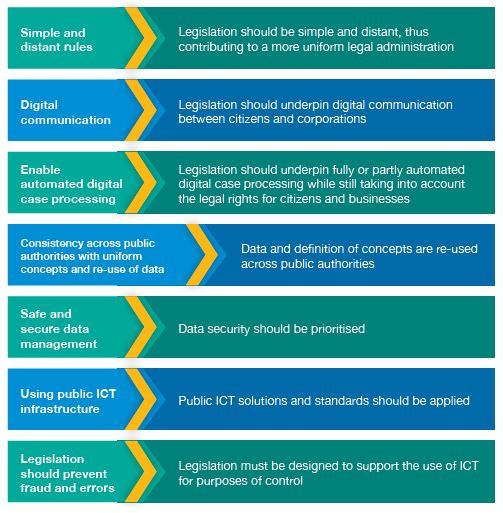
For instance, Malaysia can readily adopt best practices carried out by other countries. Case in point, the Danish parliament drafted a new legislation anchored around seven principles to ensure that the administrative consequences of its legislation become clearly delineated in the country’s policy-making processes. Meanwhile, this will definitely help lawmakers in Malaysia to assess whether the new legislation is ready for digitisation.
According to the Danish government, the seven principles for digitalisation-ready legislation are as follows:
Overcoming regulation roadblocks
For virtually every government navigating today’s highly fragile and complex world, regulations are subject to frequent adaptations. Viewed from one perspective, lawmakers are constantly improving and updating regulations to cope with rising technology advances, jarring economic and political instability as well as
social and environmental crises. If left unchecked, regulations can become a roadblock in all possible cases. And yet, excessive rigidity in regulation is an obstacle to innovation.
For the public service to adhere and appreciate law, it is important that when lawmakers enact laws, they should avoid using ambiguous content in all texts and provide a clear guidance to all the law is intended for. In addition, to enable a longer term alignment in the future, governments need to evaluate the impact of complex existing regulations and monitor the plausible implications of proposed changes.
Since the start of COVID-19’s pandemic outbreak, the ultimate wild card in strengthening legislative resilience and supporting reform initiatives requires governments to conduct a base evaluation of every legislation they currently have. Nevertheless, it is time for governments to identify which laws and acts are no longer relevant to the public service. Some laws might be obsolete as a result of technology sophistication sweeping out old working ecosystems. If not revised, these laws may become a hindrance for the public service to move forward. While some laws require an update or an amendment to accommodate a new digital working environment, other critical laws that haven’t shown their teeth need to be beefed up. Similarly, in many key areas, new types of laws are needed to promote quick and decisive public service actions. Surely, the lessons learned from the catastrophic virus outbreak will definitely be a sore reminder of why governments need to bump up their public sector readiness to prepare for unprecedented circumstances that may shake up the future yet again.