The recent difficulties media outlets have had using this newest invention to spread information across the nation.
One young adolescent girl who had to climb a tree to get a broadband connection, for instance, demonstrates the need to close a number of gaps, including those in technology, communication, society, the economy, and the way the government delivers services. COVID-19 proved that if one person contracts the disease, others can catch it as well. So, inclusivity should be the guiding principle of the twenty-first century.
The media does not face these difficulties by themselves. In actuality, it comes from the overall image of our society at the time. It is thought that more people are involved in the conversation now that there are digital communities. However, because of the imbalance in these aforementioned gaps, many people are still struggling to catch up. The gap between society and the world serves as a metaphor that the media must bridge.
The field of journalism requires both art and science; hence it needs to adhere to morality, facts, and scientific conventions. A code should define the boundaries of media posts. However, anyone can now post anything due to the advent of the internet and sites like Facebook and Google. We must keep in mind that the information supplied should be reliable to use and that it must originate from a trustworthy source, such as a journalist who abides by this code. It is very difficult for everyone to determine a social media post’s genuineness because many depend on the algorithm. These are the current problems that the media is having due to the development of technology.
The advantages and disadvantages of having the ease of sharing news.
The advantage of having the technology to spread the news has made it easy for journalism because journalists do not have to go out to get stories. We can use secondary sources from the internet. People who enjoy taking pictures and sharing them on social media are everywhere. People in the vicinity of a landslide, for instance, could assist in providing the journalist with information so they can report it to the world since it is difficult for a journalist to travel to the destination immediately from the headquarters in the event of a landslide.
Having this convenience has a lot of benefits. For instance, artificial intelligence (AI) can automatically create material, making the journalist’s job easier. The drawbacks are we become further removed from God’s most significant creation-the soul and mind, and the more technologically dependent we become. There lies the root of the problem; not only there is a lack of experience and understanding, but most importantly, it lacks in compassion.
The issues and limitations of using technology to replace journalists with netizens.
We are aware today one spark can put fire to beautiful things that took years to build. Since scientists, and philosophers began discussing these issues in the 18th and 19th centuries, we can say that this is the age of chaos. There are numerous communication channels, online users, platforms, and calculable algorithms in today’s internet-based environment. Once it is set up to move, we no longer have control over it since there are too many calculations, communications, and external variables. Hopefully, journalists and netizens can exist and co-exist. However, there is a difference between a journalist posting a news article and a netizen doing the same. The goal is that this will be taken as evidence that the journalism industry should be taken into account, addressed, and assisted rather than sensationalising viral information that is not supported by a reliable source.
At the end of the day, even in the age of chaos, I believe that journalism is like an intermittent flashing light in the tunnels of chaos.
The media’s influence on how “the hurricane” is portrayed.
This is hyper-reality; people never actually consider reality, but because the media has reported that something is true, they automatically accept it without verifying the accuracy of the story. In light of this, it is currently impossible to distinguish between reality and “hyper-reality.” In some ways, new technology has made it easier for the media to dominate and alienate the rest of the globe. This is so that all of that can be empowered by the media.
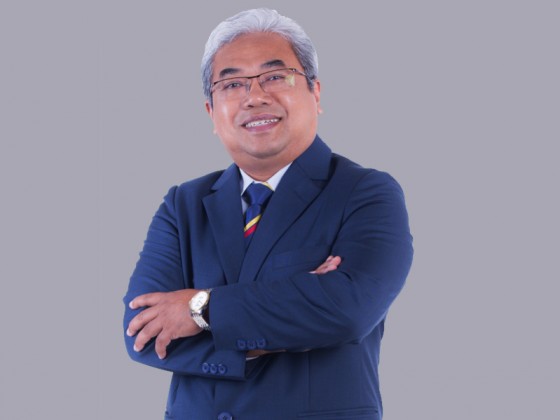
Kamarul Bahrin Haron
Kamarul Bahrin Haron is no stranger to the broadcasting world. This story teller has made a stellar career as a journalist/editor/anchor and has been in the print, broadcasting and digital media industry of Malaysia. His last stint was that of an Editor-in-Chief at Astro Awani. He has had a cornucopia of a 24-year journey in the media.