Space Economy: why is it significant?
The space economy has been pursued for decades by developed nations in order to exhibit their technological prowess and, at the same time, benefit from the business and research development involved. Space has always been seen as the next frontier for human exploration and survival. There are many examples where the technology and outcomes from the space industry were cascaded to other sectors and applications.
The significance of the space industry for developing countries like Malaysia is undeniable since it offers great potential for the modernisation of traditional sectors like agriculture, fisheries, mobility, gamification and construction. With the potential of far-reaching satellite applications and bigger international space stations, the next 10 to 15 years could bring about significant progress in these areas.
Therefore, it is crucial for Malaysia to focus on the space industry’s potential in transforming new and emerging sectors and harnessing its potential for the betterment of humanity.
Developing indigenous technology
Malaysia aspires to become a significant space player by setting high aspirations and goals that will inspire and motivate the younger generation. Therefore, we need to cultivate innovative and knowledge-sharing mindsets. For instance, JFK’s goal of sending a man to the moon captured the imagination of the American people and motivated them to work hard to become the leading player in space. Similarly, Malaysia can set ambitious goals that will excite and motivate our people to be competitive and achieve greatness together.
Another factor to take into consideration is that sufficient resources, including a significant budget, is essential in the space industry. Countries like China and the United States are continuously investing billions of dollars into the industry every year. Therefore, Malaysia needs an adequate budget and a clear framework that will align industry stakeholders, including government, industry, academia, NGOs and partners, to work together and leverage their collective strength. Through collaboration and co-creation, Malaysia can expedite its space industry development “without re- inventing the wheel” by working closely with like-minded nations and organisations.
Developed countries have been collaborating for years, as seen in the International Space Station programme involving the United States, Europe, Russia, and China. The next decade will see developing nations initiating and developing their own competencies by working together. For example, Malaysia and Türkiye have started developing initial plans to collaborate in the sector. Furthermore, within the ASEAN region, there is a huge potential for countries to join forces and benefit from applying the technologies in the space sector to other sectors.
One lesson we can learn from the space industry is that the country’s aspirations and high hopes will capture the imagination of the people and propel progress. Young people will be motivated to be innovative and knowledgeable and further inspired to pursue high-value jobs such as astronauts, engineers, data scientists and technologists that will further contribute to transforming Malaysia into a developed nation.
The space industry offers huge economic, institutional, regulatory, talent and technology development opportunities. Collaboration and co-creation will optimise our resources, while aspiration will drive our effort and motivation toward successful development of the space industry.

Space Consortium: Away forward
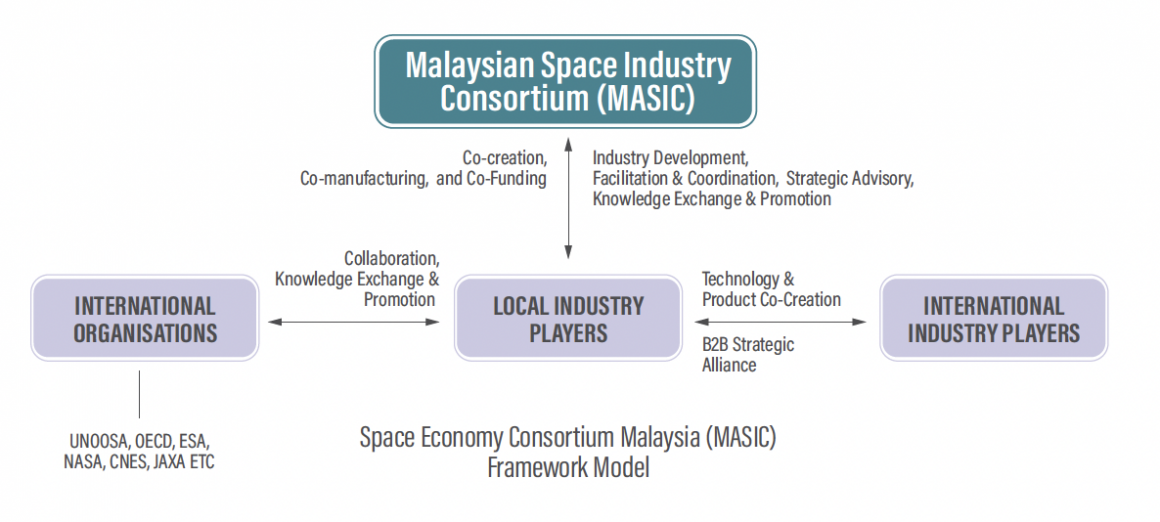
The recent establishment of the Malaysian Space Industry Consortium (MASIC) will serve as the focal point in linking industry players, Government and academia to work together, improving the capability, capacity and ultimately the competitiveness of the Malaysian space industry. MASIC will also act as the coordinator to oversee the implementation of the strategies in the Space Industry Strategic Plan 2030.
Co-funding between the public and private sectors should be the new business model for Malaysia. This model will provide equal sharing of responsibilities and decision- making in formulating and coordinating the space industry development programme. Malaysia will also continuously benchmark best practices by other countries and international companies. This will ensure the benefit of private and public investment is maximised for the local space industry and other industries supporting it.
With more players expected to join the industry, the need for better management of assets and initiatives is critical. Malaysia should produce a larger pool of talented individuals and leverage the diaspora that will bring their expertise and experiences back to Malaysia. Complementing this, we need to facilitate capability and capacity development programmes in targeted space technologies and products through the empowerment of local industries and startups.
We are currently experiencing a pivotal moment in the space industry, where more and more countries, including developing nations, are recognising the importance of being involved in space technology and programmes. We can’t afford to be left behind! I am excited about the space industry’s next ten years and hope our space aspirations will become a reality.