by | Thomas Hayes, Global Food Technology & Innovation Analyst, Lux Research
Thomas Hayes is an emerging technology analyst skilful in helping industry leaders drive growth through innovation. He is proficient in creating frameworks to translate complex and ambiguous topics into easily understandable depictions that inform technology strategy. As such, Thomas Hayes blends more than five years of experience in market research, consulting, and traditional engineering settings and offers a diverse set of technical and business skills to transform research to reality.
Why does consumerism matter now more than ever Lux Research defines
Consumerism is certainly not a new concept. We can even look back to the 1970s when a pioneer of sorts in consumerism, Burger King, famously introduced the mantra “Have It Your Way.”
In 2014, Burger King ditched their age-old slogan and changed it to “Be Your Way” in an effort to create a connection with the consumer’s greater lifestyle, going beyond just their food order. This encapsulates the essence of what consumerism
• What does the consumer lifestyle journey look like in terms of food and health?
• How are emerging technologies opening up new channels to make connections with consumers?
• How can players in the ecosystem capitalise on shifts in consumerism?
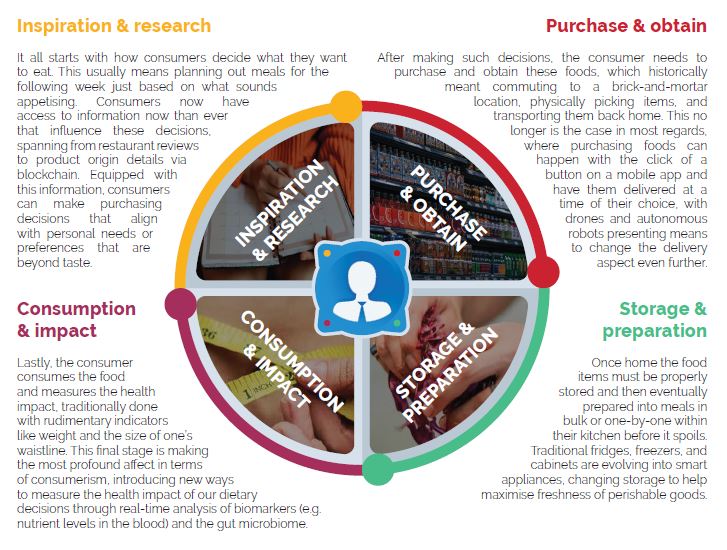
Lux Research defines the consumer journey as it relates to food and health in four distinct steps, occurring in a cyclical manner:
These shifts in consumerism are driving the development of emerging technologies that are transforming this consumer journey greatly, all introducing varying elements of personalisation, the most consumercentric megatrend facing the industry today. Taking a step back, this transformation points towards consumer expectations increasing as products must cater to their needs and preferences at any time, and players within the food and health ecosystem need to act accordingly.
Where you can play in the age of immense consumer demand?
Capitalising on the evolving consumer is certainly easier said than done though. Industry already has enough SKUs, is combatting razor thin margins, and needs to maintain throughput and safety when making products. It’s all about evolution, not revolution, and moving at least in the direction of consumer-centric products. By first identifying the relevant opportunities within the food and health ecosystem, along with the key technologies to help seize those opportunities, one can begin that evolution.
Food: Inverting production and distribution in your supply chain to become closer to the consumer
As consumers look to obtain products more quickly and at an increased level of personalisation, the time between when the “right” formulation of a food product is identified and when that product is in the consumer hands needs be shorten drastically. This brings the cycle time of product development, production, and distribution down by a factor of at least 25, going from one to two years to one to two weeks, forcing brand owners to completely rethink how these processes are done today. It means executing these processes closer to the consumer in terms of design and location, which requires both flexible manufacturing and decentralisation of operations. The key technologies to leverage include:
• Soft robotics. On the flexible manufacturing front, soft robotics allows the selection of foods with nontrivial textures off a conveyor belt. This helps enable packaging of specified foods for an individual.
• Last-mile transportation. Drones, sidewalk robots, and autonomous vehicles all present means to deliver foods between a penultimate location and the consumer without human labor.
• 3D printing. Albeit restricted to high-value/low volume use cases, the ratios of ingredients can be precisely controlled when 3D printing food to arrive at a uniquely designed formulation.
Health: Helping consumers optimise health with every decision
With health, the notion of being closer to the consumer is paramount. It’s all about helping consumers optimise health with every decision they make throughout the day. A consumer-focused health regime will not only curb growing healthcare costs, but also shift the paradigm from reactive to preventative. The key technologies to leverage include:
• Personalised nutrition. As mentioned before, new ways of analysing biomarkers and the gut microbiome are opening up doors to measure the health impact of foods. Genetics can also play a role here, but in the inspiration & research phase rather than impact.
• Electronic textiles. Sensors embedded within textiles can offer the same functionalities as a wearable electronic, if not more, to continuously monitor and provide recommendations based on vitals.
• Precision medicine. On the therapeutics side, designing drugs based on genes, environment, and lifestyle of an individual can help tailor a payload in order to optimise efficacy.
How to begin your organisation’s evolution
It’s important to crawl, walk, then run in this evolution. Begin by offering decision support tools that navigate consumers to products that match their needs or preferences. This starts nurturing a relationship between your organisation and the consumer, while requiring no manipulation of existing SKUs. Then look to create products that align with the profiles of consumers within a targeted demographic. This will add more SKUs, but doesn’t come with the challenges of customsing products down to the individual level. But as the highlighted enabling technologies mature, truly consumercentric products will become more feasible, and those organisations delivering on this will secure their place in the ever so increasingly consumer-driven world.