by | Azmil Mohd Amin, azmil@might.org.my
On the 11th of July every year, an event known as the World Population Day has been celebrated for almost three decades. The aim of this day is to focus the world’s attention on the importance of population issues. According to a 2017 UN report, current world population of 7.6 billion is expected to reach 8.6 billion in 2030, 9.8 billion in 2050 and 11.2 billion in 2100. With roughly 83 million people being added to the world’s population every year, the upward trend in population growth is expected to continue, despite widely held assumptions that fertility levels will continue to decline.
There are many challenges related to the environment that dominate the public domain such as climate change, consumption, food security, water shortages and pollution. As a result, attention on overpopulation often get neglected. The lack of coverage also leads many people to believe that overpopulation will not impact them, which could be an elephant in the room.
A few highlights from the Population Reference Bureau (PRB) mid-century population projections in the 2018 World Population Data Sheet state:
• The population of 26 countries, nearly all in Africa, will at least double. Niger in West Africa will see its population nearly triple.
• A total of 38 countries will have smaller populations in 2050 than in 2018. China will register the largest numerical population decrease― about 50 million― followed by Japan at 25 million and Russia at 9.4 million. Romania will see the largest percentage decline in population (23%).
• The population of the United States will reach 390 million, up from 328 million in 2018.
• China’s population will decrease by about 50 million from its current size to 1.34 billion. India will supplant China as the world’s most populous country with 1.68 billion people.
• Nigeria will become the third most populous country as its population rises to 411 million, up 109% from 2018. Nigeria is currently the seventh most populous country.
Causes
Overpopulation is the difference between overall birth and death rates in populations. As a rule of thumb, if the number of children born each year equals the number of adults that die, it is fair to deduce that the overall population size will stabilise. However, previous industrial revolutions have brought about a flurry of technological advancements and perhaps, this is the biggest reason why today’s population equilibrium gets disrupted. To date, science and technology have enabled us to produce better means of producing food, hence allowing families to feed more mouths. Medical science too, has made many breakthroughs. Of which, these new discoveries are providing solutions to overcome a wide range of diseases. Illnesses that had claimed thousands of lives can now be cured following the invention of vaccines. Combining the increase in food supply with fewer means of mortality have tipped the balance and could become the starting point of overpopulation. With the latest technological advancement and discoveries in medical science, it is now possible for women who are unable to conceive to undergo fertility treatment and have children. There are effective medicines that can increase the chances of conception and this can therefore lead to the rise in the world’s overall birth rate.
Poverty is also believed to be the another cause of overpopulation. The lack of educational resources, coupled with a high death rate are leading to the increase in global birth rates. As a result, impoverished countries are seeing a large boom in population. The impact is so widespread, the UN has predicted that 48 of the world’s poorest countries are likely to be the biggest contributors to overpopulation. Their estimates state that the combined population of these countries is likely to inflate to 1.7 billion in 2050, from 850 million in 2010. With most developing nations having a large number of illiterate citizens who live below the poverty line and have little or no knowledge about family planning, chances of getting their children married at an early age will only increase. Consequently, this increases the odds of these countries’ citizens having more kids.
Implications
The impact overpopulation places on the environment is perhaps the most obvious immediate concern. The rise in
the number of companies draining the planet’s resources to meet the demand for production causes, mass exploration of natural resources, deforestation and water pollution is worrying to say the least. Compounding the situation is the increase in the number of vehicles and industries badly affecting air quality. In addition, the rise in the amount of CO2 emissions is also adding to global warming’s dangers. Melting polar ice caps, changing climate patterns, and the rise in sea levels are a few more consequences that the world population at large is currently facing.
The earth can only produce a limited amount of water and food. At present, supply is deteriorating as current needs increase. As such, most of the environmental damage in the last fifty odd years is caused by the growing number of people on the planet. Deforestation for instance, has caused pollution and disrupted water catchment areas resulting in shortages of fresh water supply. According to the Global Outlook for Water Resources to the Year 2025, it is estimated that by 2025, more than half of the world’s population will be facing water based vulnerability and human demand for water will account for 70% of all available freshwater. Meanwhile, according to the World Resources Institute, freshwater ecosystems–the diverse communities found in lakes, rivers, and wetlands–may be the most endangered of all. Freshwater ecosystems have lost a great proportion of species and habitats than ecosystems on land or in the ocean. They are probably in greater danger of further losses from dams, pollution, overfishing, and other threats. In large, freshwater ecosystems are quite limited, covering only about 1% of the earth’s surface. Yet, they are highly diverse and contain a disproportionately large number of the world’s species. Unfortunately, as human populations grow, so will the problem of clean freshwater availability.
A World Health Organisation (WHO) report shows that environmental degradation, combined with the growth in world population, are two major causes of the rapid increase in human diseases, which contribute to the malnutrition of 3.7 billion people worldwide, making them more vulnerable to diseases. According to WHO, every three seconds, a young child dies—in most cases from infectious diseases. In some countries, one in five children dies before their fifth birthday. Everyday 3,000 people die from malaria—three out of four of them are children. Every year 1.5 million people die from tuberculosis and another eight million are newly infected.
How do we deal with this?
One of the early measures that can be taken is to implement policies that reflect social change to address the unique needs of each respective country with regard to overpopulation. Educating the society helps them understand why a reasonable family size and the number of children they can have need to be in line with the government’s policies and planning. Such approach may sound simplistic, but national family planning policies can help women make their own reproductive choices. As the world’s population is growing at a rapid pace, raising awareness regarding family planning and educating the society on effects of overpopulation can help curb the issue.
Policy intervention in relation to tax exemptions for countries facing the situation could also provide another solution. Governments can waive a certain part of the income tax or lower tax rates for married couples who have one or two children.
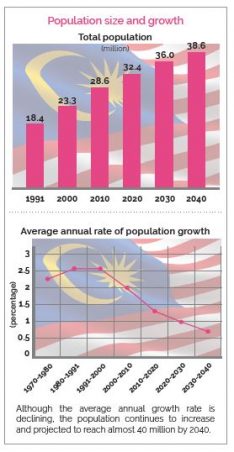
However, such long-term policy interventions might pose many new complications. For instance, in the case of China, falling birth rate has taken a big toll on the country’s economy as a result of decreasing working age population. Between 2010 and 2030, the United Nations projected that the country’s working age population could shrink by around 7%, which translates to fewer workers generating tax revenue to cover the rising number of retirees requiring social benefits. In such cases, these long-term demographic problems mirror those that are already facing other countries like Japan. Malaysia in this context recognises the inter-linkages between population and development processes. The government understands that continued population growth does not necessarily have a negative effect on development. A larger population, and the increased domestic market can be beneficial in achieving national development goals provided that quality and productivity of the population are constantly raised. A population size of 70 million was identified as the ideal target Malaysia should aim for by 2100. With these challenges in mind, aligning decision makers at the highest political and administrative levels can help maintain the nation’s commitment over the long term. This support system, especially as the 4th industrial revolution, digitalisation and automation are beginning to gain ground, will help us choose metrics to measure better action, policies and the needs of an evolving population.